Have you ever noticed how much energy we spend trying to protect our happiness? We build mental fortresses, hoping that if we just stay positive enough, visualize our success enough, or manifest the perfect outcomes, nothing will go wrong. We treat unexpected disruptions like personal insults from the universe. A delayed flight, a sudden drop in business revenue, or an unprovoked argument with a loved one can completely shatter our emotional stability for days.
Our modern culture tells us that the secret to a good life is aggressive, unyielding optimism. “Think positive,” the gurus say. But ancient Roman and Greek philosophers discovered a counterintuitive truth over two thousand years ago: absolute optimism makes you fragile.
When you only prepare for sunny days, the first raindrop feels like a hurricane.
To build a mind that cannot be shaken by the chaos of the world, you do not need more positive thinking. You need a structured, ancient psychological tool known as Premeditatio Malorum—the intentional practice of negative visualization.
What is Premeditatio Malorum?
Translated from Latin, Premeditatio Malorum literally means the “premeditation of evils.” It is the mental exercise of intentionally imagining worst-case scenarios before they happen. If you want to build this level of psychological defense, mastering The Stoic Art of Emotional Resilience is essential to understanding the full mental fitness landscape. To the untrained mind, this sounds like a recipe for clinical anxiety, but it is actually the ultimate tool for inner peace.
To the untrained mind, this sounds like a recipe for clinical anxiety or chronic pessimism. It sounds like overthinking. However, there is a massive structural difference between worrying and practicing premeditation.
- Worrying is reactive, chaotic, and driven by fear. It happens to you when your mind spins out of control at 2:00 AM, replaying vague, terrifying uncertainties.
- Premeditatio Malorum is active, controlled, and driven by reason. It is a conscious, structured meditation where you look directly at your fears, analyze them calmly, and dismantle their power before they can surprise you.
The great Stoic philosopher Seneca beautifully summarized this concept in his letters: “He robs present ills of their power who has perceived their coming beforehand.”
By looking at potential disasters in the controlled laboratory of your own mind, you remove the element of shock. And in human psychology, it is rarely the event itself that destroys us—it is the shock of the event.
Why Positive Thinking Alone Makes You Fragile
We live in an era obsessed with comfort and positive affirmations. While optimism has its place, relying on it exclusively creates a dangerous psychological blind spot. When you expect everything to go perfectly, you become emotionally exposed.
Consider how most people approach a major life event, such as starting a new business or entering a serious relationship. They indulge in beautifully curated daydreams. They see the profits, the praise, the perfect harmony, and the smooth sailing.
When a business encounters a hurdle or a relationship hits a communication barrier, the toxic optimist panics because they never allowed their mind to visit the valley of failure. To manage these moments without feeling overwhelmed, practicing The Stoic Art of Balance will teach you how to stay calm when life feels heavy and challenges start to pile up on your shoulders.
But reality does not operate on a script.
When the business encounters a regulatory hurdle, or when the relationship hits its first major communication barrier, the toxic optimist panics. Because they never allowed their mind to visit the valley of failure, they have no emotional map to navigate it. They feel blindsided, cheated, and overwhelmed.
Premeditatio Malorum acts as an emotional vaccine. By introducing a small, controlled dose of the “virus” (the mental image of adversity) into your system, your psychological immune system builds the necessary antibodies. When the actual adversity strikes, your mind does not panic; it simply recognizes the situation and executes the plan.
The Three Core Pillars of Negative Visualization
To practice this art naturally without spiraling into anxiety, you must understand the three distinct ways it transforms your relationship with reality.
1. The Erasure of Shock
Human beings suffer twice as much when an event catches them completely off guard. If you walk out of your house expecting beautiful weather and it suddenly pours down raining, you feel angry. If you checked the weather forecast and knew it was going to rain, you walk out with an umbrella and a calm mind. The rain is exactly the same in both scenarios; your emotional reaction is entirely dependent on your expectations. Premeditatio Malorum ensures you are never caught without your mental umbrella.
2. Radical Gratitude (The Reversal of Loss)
We naturally get used to the good things in our lives—a psychological phenomenon known as hedonic adaptation. We take our health, our partners, our stable incomes, and our daily comforts for granted.
When you sit quietly and deeply imagine losing those things—imagining what your life would look like if your bank account was emptied, if your health failed, or if it was the very last day you could see your best friend—something miraculous happens. You do not become sad. Instead, when you open your eyes and return to reality, you look at your life with a profound sense of awe and appreciation. You realize that the things you have are temporary gifts.
3. Immediate Proactive Action
When you map out exactly how a project, a day, or a phase of life could go wrong, your brain naturally shifts into a problem-solving mode. Instead of waiting for a crisis to occur, you begin to quietly reinforce your weaknesses today. It turns abstract anxiety into an actionable checklist.
How to Practice Premeditatio Malorum in Daily Life
You do not need to sit in a dark room for hours visualizing tragedy to reap the benefits of this philosophy. You can weave it seamlessly into your modern routine using three practical frameworks.
The Micro-Check: Before Your Day Begins
During your morning routine, right after you look at your calendar, take exactly two minutes to run a mental simulation of your day. Do not just see the successful meetings; intentionally visualize the friction points.
- What if my coworker shows up late to our presentation?
- What if the traffic is completely deadlocked and I am late?
- What if my client rejects the proposal I worked on all week?
Tell yourself, as Marcus Aurelius did every morning: “The people I deal with today will be meddling, ungrateful, arrogant, dishonest, jealous, and surly.” When you explicitly tell your brain what to expect, you will not lose your temper when people act exactly like flawed human beings.
…as Marcus Aurelius outlined in his Meditations every morning: “The people I deal with today will be meddling, ungrateful…”
The Macro-Check: The Pre-Mortem Strategy
Before launching any major project, career change, or financial investment, gather your thoughts (or your team) and conduct a “Pre-Mortem.”
Assume that it is now twelve months into the future, and your project has completely, catastrophically failed. It is a total disaster. Now, write the history of that failure. Why did it fail? Did the market shift? Did communication break down? Did you run out of capital?
By looking backward from a hypothetical failure, you will spot the fatal flaws in your current plan that your optimism intentionally blinded you to.
The Existential Check: Embracing Impermanence
Once a week, look at the things you hold closest to your heart and gently remind yourself that they are on loan from nature. Your career, your material possessions, your physical youth, and even the people you love cannot stay forever. This is not morbid; it is the ultimate expression of love. It strips away trivial arguments, silences minor complaints, and forces you to show up fully in the present moment.
The Boundary: Distinguishing Meditation from Anxiety
The most common objection to this practice is: “Won’t this manifest bad things into my life?” or “Won’t this make me constantly anxious?”
The boundary lies entirely in your execution and intent. Anxiety is passive; it loops endlessly on the question “What if?” without ever arriving at an answer. It leaves you feeling helpless.
Premeditatio Malorum is active; it asks “What if?” and then immediately answers with: “Then I will adapt by doing this.” It concludes with a sense of internal readiness. You are not dwelling on the disaster; you are mastering your emotional relationship to it.
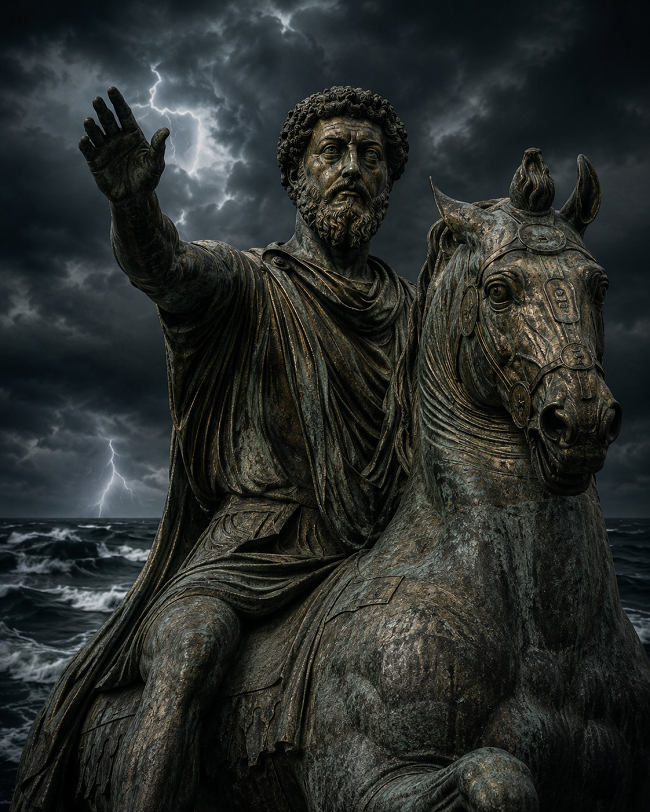
Furthermore, Stoicism teaches us that we do not control external events, but we have absolute control over our internal character. By visualizing external storms, you realize that your internal pilot is fully capable of steering the ship, no matter how high the waves grow.
Conclusion: True Peace is Found in Readiness
True peace of mind is not the absence of trouble; it is the absolute confidence that you can handle trouble when it arrives.
When you spend your life running away from the thought of failure, discomfort, and loss, you live as a psychological fugitive. You are always running, always anxious, and always hoping the world treats you gently.
But when you master the Stoic art of Premeditatio Malorum, you stop running. You look directly at the shadows of what could go wrong, you welcome them into your mind, and you make peace with them. You realize that even if the worst happens, you are still here, your character is intact, and your mind is unbroken.
Tomorrow morning, do not just hope for a perfect day. Prepare your mind to conquer a chaotic one.